
Read Randolph County Property Tax Records
Randolph County property tax records rest on a simple split of duties. The Board of Tax Assessors decides taxability, sets appraisals and assessments, handles equalization, and issues notices, appeals, and exemptions. The Tax Commissioner takes over from there, sending out tax bills and collecting payments on property across Randolph County.
| Field | What It Shows | Where |
|---|---|---|
| Assessed value | Taxable assessment basis | Tax Assessor |
| Fair-market or market value | Assessor's full-value field when displayed | Tax Assessor |
| Exemptions | Deductions or classifications applied | Tax Assessor |
| Bill and payment status | Current charge, payment, or delinquency | Tax Commissioner |
| District and rate | Authorities contributing to the bill | Tax records and digest |
Georgia counties, including Randolph, commonly assess property at 40% of fair market value. Qualifying agricultural land may be assessed at 30%. Conservation use follows its own current-use rules. An assessed value is not an appraisal. A taxable value or tax bill is not a sale price either. Treat each figure as what it is.
Use the Certified Roll With Caution
The county's Search Tax Records page links to online assessment data. It carries a caution worth heeding. The last certified tax roll supplies the assessment information. Other data can shift. The qPublic/Beacon parcel interface offers no confirmed field set or payment-status screen for Randolph users. Confirm any balance through the Tax Commissioner before acting on it.
Randolph's 2025 Digest in Context
The official digest tells a story of steady growth. Gross digest climbed from $256,330,203 in 2020 to $342,338,671 in 2025. Exemptions rose over the same span, from $76,154,346 to $113,252,930. The 2025 net digest landed at $229,085,741, with a 17.1311 M&O rate and $3,924,491 in total M&O taxes levied. These countywide numbers describe the whole tax base. They say nothing about any single parcel's bill.
Look Up a Randolph County Tax Bill
Keep the assessment lookup and the bill inquiry in separate mental files, since different offices maintain them. Before sending money or trusting a balance figure, verify the current payment portal with the Tax Commissioner.
- Identify the parcel and tax year from the assessment record.
- Request the current bill and paid or delinquent status from the Tax Commissioner.
- Compare the exemptions and district shown on the assessor record.
- Record any Fi.Fa., collection, levy, or tax-sale reference separately and verify its date.
- Assessed value
- The valuation basis used in taxation.
- Millage or levy
- A rate applied in the tax calculation.
- Homestead exemption
- Approved relief tied to a qualifying homestead.
- Tax lien
- A claim arising from unpaid tax, requiring current verification.
Check Randolph Exemptions Before Comparing Bills
The captured county exemption page supplies official local guidance.
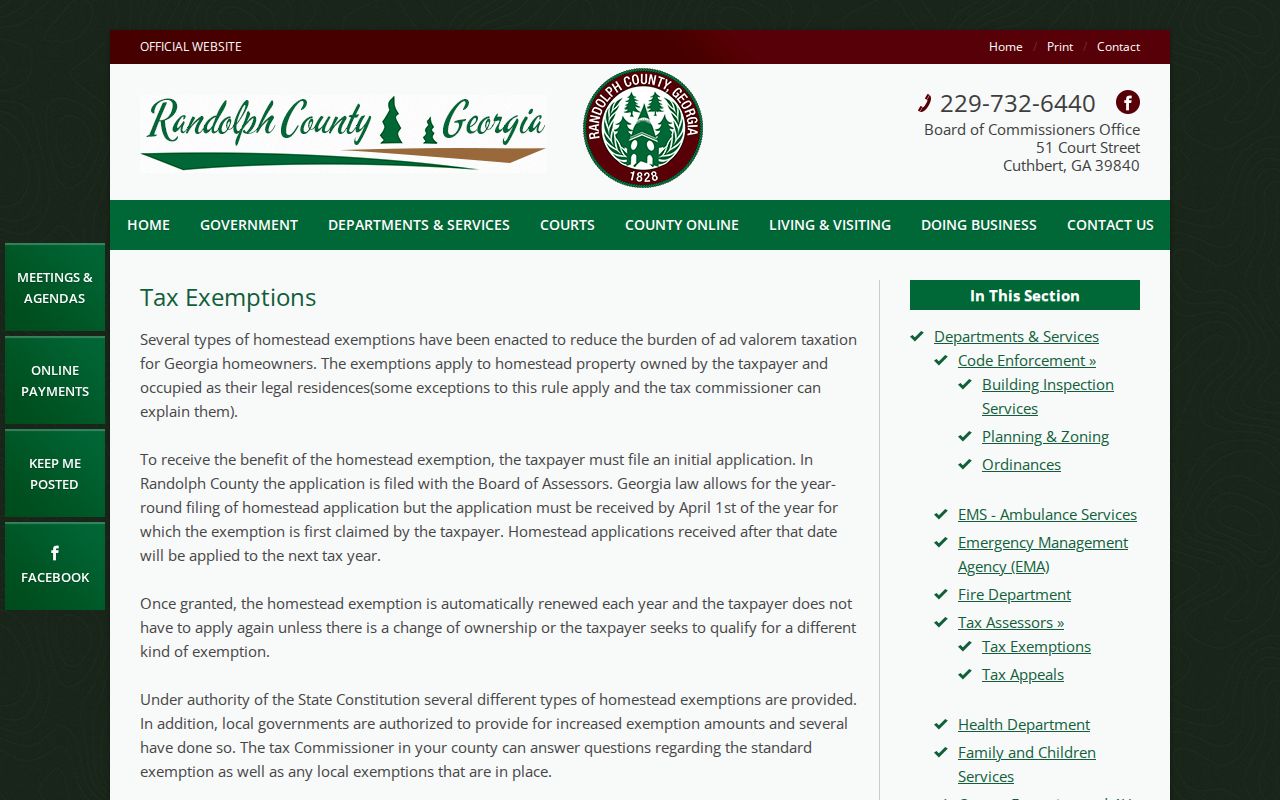
Timing drives everything with exemptions. The county's exemption guidance requires homestead applications by April 1 to count for that first year. Miss the date and the filing simply applies to the next one. The guidance covers standard homestead relief and age-based school and general relief. It also lists disabled-veteran provisions and agricultural assessment. A ten-year conservation-use covenant is included as well. Eligibility never follows from age, acreage, or an owner name alone.
Follow Randolph's Delinquency Timeline Carefully
The county newcomer page lays out the calendar. Bills go out on or about October 7 and come due December 20. Delinquency begins after 60 days. A described 1% monthly late fee applies, and a 10% penalty follows at 90 days. Fi.Fa. fees can enter the picture. Annual billing details change, so confirm every deadline against the current bill.
Separate Value, Uniformity, and the Bill
An assessment appeal has a limited scope. It can challenge taxability, value, uniformity, or the denial of an exemption. It cannot dispute the math on the tax bill or whether a payment posted. Strong evidence includes the notice itself, the parcel description, and comparable assessments. Photographs and repair facts also help. So does stating the precise ground being argued.
Appeal a Randolph County Assessment
Every parcel receives an annual Notice of Assessment. The county states this on its Tax Appeals page. File your appeal with the Board of Tax Assessors. You have 45 days from the notice date to do so. That clock is strict. If the assessor makes no change, the appeal moves automatically to the Board of Equalization. Further routes exist under county procedure and Georgia law.
Appeal window. Use the date printed on the Randolph notice and count the 45-day period; do not substitute a generic calendar deadline.
Interpret Randolph Exemptions Precisely
Randolph County offers several distinct programs. County guidance describes standard homestead relief, local age-66 school relief covering a homestead and up to five acres, age-62 school relief and age-65 general relief with stated income limits, disabled-veteran and qualifying surviving-spouse provisions, agricultural assessment, and conservation-use valuation under a ten-year covenant. Each carries its own qualifications and tax effects. A name, an age, acreage, or an apparent farm use proves nothing about eligibility or approval. When comparing bills, capture the same fields for the same tax year: exemption codes and amounts, district, classification, and land versus improvement values. Agricultural treatment at the 30% basis rather than the common 40%, plus conservation-use valuation, can produce differences that are entirely legitimate. Ask the assessor which evidence applies, and keep the approval or denial notice. Ownership or eligibility changes may require action even when an existing homestead would otherwise renew.
Use Randolph's Digest as County Context
The digest numbers move in one direction. Real and personal value rose from $244,560,433 in 2020 to $328,498,255 in 2025. The net digest climbed from $180,175,857 to $229,085,741 over the same span. The M&O rate sat at 17.6750 in 2020 and 2021. It then held at 17.1311 from 2022 through 2025. Total M&O taxes levied reached $3,924,491 in 2025. County notice material identifies a 3.97% net-tax percentage increase that year. Those totals do not mean every parcel moved by the same amount. A property's bill rests on its own assessment. Exemptions, classification, tax district, rates, and special assessments all play a part too. Compare like fields and like years. A deed transfer price may reflect a gift, a correction, a foreclosure, an estate conveyance, or a family deal rather than an arm's-length sale. Read the deed records before leaning on that price in an appeal.
Document a Randolph Assessment Appeal
Start with the annual Notice of Assessment. Record its issue date, the value, the property description, and the appeal directions. Note the 45-day deadline. Then pick the actual ground, whether taxability, value, uniformity, or denial of exemption. Gather evidence that speaks to that ground. Dated photographs, repair estimates, and condition facts can help. Verified sales and comparable assessments for similarly classified property can help too. Keep proof that you filed on time. The assessor reviews the filing first. County guidance says an unresolved appeal proceeds automatically to the Board of Equalization. Arbitration may apply in described circumstances, and a Superior Court route exists beyond that. Later stages carry procedural consequences, so verify the current notice and instructions. Payment posting, delinquency, and bill arithmetic stay with the Tax Commissioner rather than the appeal.
Reconcile Bills, Liens, and Payment Status
A Randolph County tax bill changes fast, so capture the details while they matter. Record the bill year, parcel number, taxpayer name, tax district, original amount, and due date. Note the payments and any interest or penalty. Record the status tied to a stated retrieval date. A Fi.Fa., levy, tax-sale notice, or cancellation may show up in the property records. Pull the current official document. Do not trust a stale online line to still be operative. Confirm the county's October and December deadlines for the bill year you hold. Confirm its fee schedule as well.
Assessment records and collection records run on separate schedules in Randolph County. A corrected value does not mean the tax bill was recalculated. A payment receipt does not change the assessment roll. Keep assessor notices, appeal decisions, Tax Commissioner statements, and recorded lien documents in separate folders. Cross-reference each one by parcel number and tax year. The deed, tax roll, and billing chronology stays auditable.
Audit a Randolph Tax Record by Year
Build one row per tax year instead of mixing values from different notices. Capture fair-market value, assessed value, and taxable value. Alongside those, log land and improvement components, exemptions, classification, district, and rate. Add the original bill, payments, penalties, and balance only when those labels actually appear in the property records. Log the source, any certification or update language, and the retrieval date. Where the live portal does not expose a field, mark it unavailable. Ask the custodian instead of estimating.
Compare each assessment notice with the same year's certified tax roll and bill. The notice starts the appeal clock. The certified roll supports assessment information, while the bill reflects the collection calculation. A later correction may reach those systems at different times. So keep appeal decisions, corrected notices, Tax Commissioner statements, receipts, and recorded lien or cancellation documents separate, cross-referenced by parcel and year.
For delinquency work, verify whether the amount shown includes interest, penalties, Fi.Fa. charges, levy expenses, or other costs. Ask for an as-of date too. An older balance or legal notice does not prove a lien remains unpaid or a sale is pending. A parcel-card owner of record does not establish who received the current bill either. Confirm the operative collection record directly before drawing conclusions.
For value comparison, use verified comparable properties with consistent classifications. Distinguish the assessor's fair-market field from an appraisal, listing, offer, or recorded sale consideration in the deed records. Check whether an exemption explains the difference. Agricultural treatment, a conservation covenant, a non-arm's-length transfer, a split, or an improvement change can too. Weigh all of these before claiming unequal treatment. These steps sharpen a 45-day appeal. They also keep every tax-record interpretation tied to official Randolph County evidence.
Recheck the county's assessment, exemption, appeal, and payment routes often, because tax information is time-sensitive. Preserve the official year and as-of date beside every number. If the payment portal is unavailable, go to the Tax Commissioner. Do not rely on an old balance. Randolph County property tax records should let a reader separate what the assessor decided, what exemption was approved, and what the Tax Commissioner billed. They should also show what was paid by each deadline. That separation keeps countywide digest figures from being mistaken for a current parcel obligation. Stale portal data stays separate too.
Note: Always confirm the parcel number, tax year, and responsible office before acting on any Randolph County tax figure or deadline.