
Start with the official GSCCCA Real Estate Name Search, the modern name index for Randolph County deed parties.
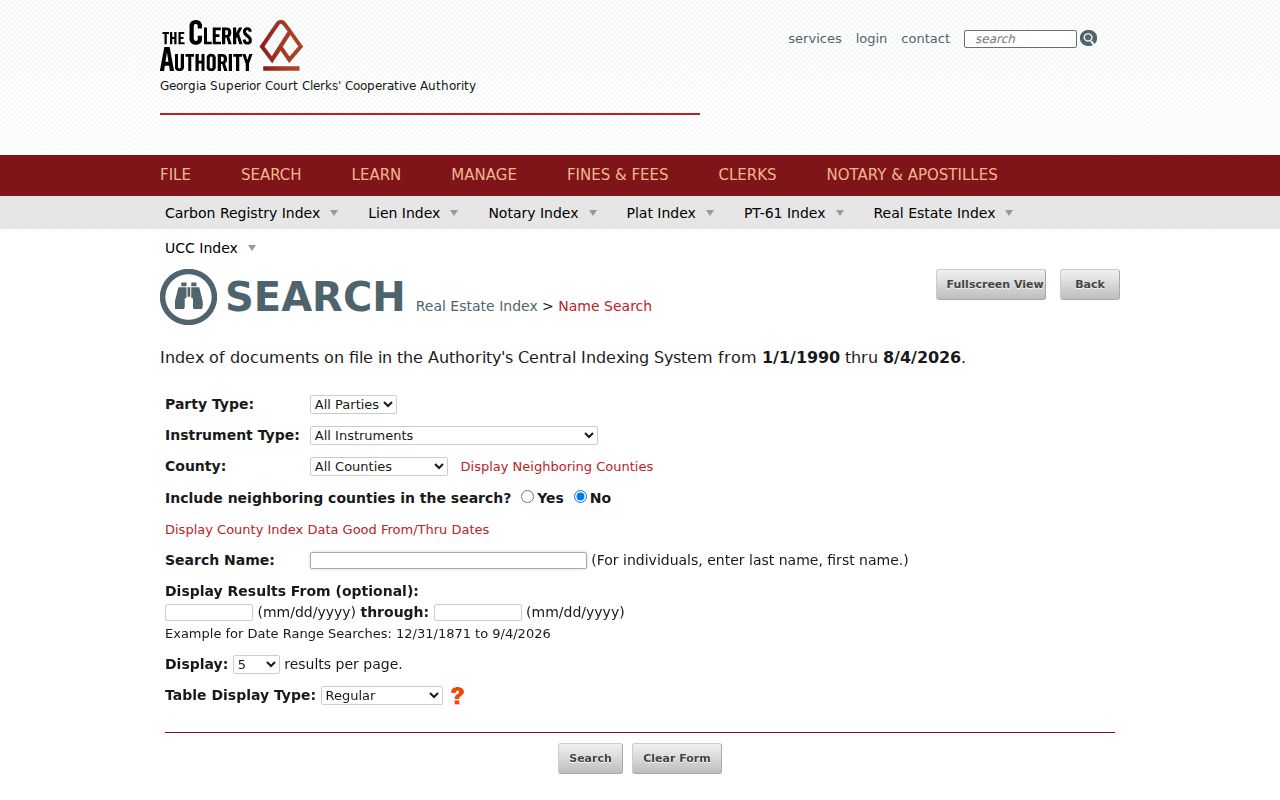
The GSCCCA name search form displays its search controls. It does not show a finished owner chain, so every result still needs a parcel and deed match.
Trace Back Randolph County's Former Owners
A backward timeline grows from the current deed citation. Every row should keep the transfer date, the recording date, grantor, grantee, deed type, and book/page. Keep the parcel's legal description beside each name too. That habit stops a same-name deed for other land from slipping into the chain.
| Transfer point | Grantor to grantee | Instrument | Citation |
|---|---|---|---|
| Newest verified deed | Named seller to named buyer | Preserve actual type | Instrument or book/page |
| Prior acquisition | Prior owner as earlier grantee | Deed or estate instrument | Earlier book/page |
| Plat or split | Ownership may continue while land changes | Plat, replat, boundary agreement | Plat book/page |
| First unverified link | Record names and gap plainly | Offline book or probate lead | Last confirmed citation |
Begin online with a modern name or citation. Then try the clerk terminal, Kofile index volumes, FamilySearch, the Georgia Archives, probate packets, or historic newspapers. Offline spans simply call for the next shelf of records.
Reconstruct Randolph County's 1913 Index Clue
One Kofile grantor volume offers a concrete example. It lists Giddon Russell as grantor and Randolph C. Federal Savings Bank as grantee. The deed is dated October 22, 1913. It covers city property and 10 acres, at Book 143, Page 145. Treat the row as a lead, not proof of the whole deal. Before either party joins a parcel history, pull the instrument and compare its legal description, since an index can abbreviate names, compress land text, or describe a security interest rather than a sale.
Recover an Offline Randolph County Book
The Superior Court clerk keeps a public terminal at 93 Front Street, Room 118, in Cuthbert. Bring the last confirmed party, instrument type, book/page, date, and land description, and request any unavailable volume specifically. Ask about copy format and current cost. FamilySearch tax-digest and probate collections, Digital Library of Georgia holdings, and Georgia Historic Newspapers can supply leads. Tax lists and notices may bridge a question. They still do not replace a deed.
Go Back Through Randolph County Deeds
The GSCCCA name index offers filters for party type, instrument type, county, search name, and date range. Try spelling variants and search both party roles. The land description stays your constant throughout.
- Find the newest deed with the present party as grantee and verify the parcel description.
- Read its grantor, capacity, date, exceptions, and earlier citation.
- Search that grantor as an earlier grantee, allowing for initials, married names, estates, and entities.
- Repeat until a book is unavailable, then record the gap and switch access channels.
- Grantor / grantee
- The conveying party and receiving party named in the instrument.
- Chain of title
- The linked sequence of recorded interests, subject to identified gaps.
- Reverse index
- The grantor side used to follow a prior owner backward.
- Warranty / quitclaim
- Different deed types that carry different promises.
Follow Randolph County Estate Transfers
A seller-to-buyer sequence can break when an owner died. Search executor, administrator, trustee, estate, life-estate, and fiduciary forms of the name. Probate files may identify heirs or authority. Only the recorded instrument supplies the true conveyance. A decedent on a tax roll, an administrator signing a deed, and an heir named in an order are separate facts. Keeping each role exact keeps unrelated records from posing as ownership proof.
Read Randolph County Plats Beside Past Deeds
The GSCCCA Plat Search filters by county, name, section or GMD, and district. It also narrows results by land lot and dates. A plat can explain a confusing deed description. Replats, dedications, easements, and boundary shifts appear there. For rural land, compare acreage, roads, creeks, districts, and survey references. Old streets and lot numbers may matter more in town. Planning & Zoning reviews subdivisions, while the clerk holds the recorded plats.
Track Randolph County Name and Street Variants
Cuthbert's square and historic district can anchor a search when modern address terms fail. Shellman works the same way. Its railroad, depot, Park Avenue, Railroad Street, and historic grid offer parallel leads. Landmarks orient research, though. They do not prove a parcel match. Run surnames with initials and full names, entity abbreviations, trustee wording, and old road forms, then demand continuity in the legal description.
Audit More Than Randolph County Deeds
Former owners form the spine. Liens, security deeds, cancellations, easements, boundary agreements, plats, lis pendens, and probate records explain events between transfers. Search them when a deed references one. A gap in the chain warrants the same effort. Single-instrument retrieval belongs in the deed records guide, while the current assessment snapshot lives on the current property owner page rather than in this backward timeline.
Treat Randolph County previous owners as verified links rather than a loose pile of names. Each prior owner belongs beside the deed that tied them to the parcel. A name found only in a tax digest, newspaper notice, or probate lead is a clue. It is not a conclusion. Follow it to the recorded instrument. Former owners also resurface in easements and corrective deeds without ever holding the parcel again. Separate columns for previous owners, prior owners, and document roles keep the ownership history readable. They also keep it honest.
When a deed cites an earlier instrument, chase that citation before trusting a name search alone. Book and page references sidestep spelling problems and expose exceptions carried forward for decades. File releases, easements, plats, and probate instruments beside the timeline. A later reader then understands why a parcel description or party capacity shifted.
A thorough historical worksheet needs more than owner names. Record execution and recording dates and the exact deed type. Add land district or land lot references, acreage, plat citation, exceptions, and any road or creek calls. Track when a tax identifier changes after a split or combination. Those details separate a true break in the chain from a mere change in description.
Historic maps and newspapers offer context, not conveyance proof. The Digital Library of Georgia holds an 1867 Randolph County map plus local collections. The newspaper archive includes an 1871 Cuthbert Weekly Appeal issue. Either source can surface a place name or sale notice that opens a new property search. The deed or court instrument remains the record that settles ownership.
Mark How Far Randolph County Owner Records Reach
GSCCCA posts a portal-wide coverage window of January 1, 1990 through August 4, 2026, but that range is portal-wide rather than a confirmed Randolph County cutoff. Kofile describes Randolph County deed indexes reaching back to 1865. Completeness and image coverage vary across that span. Neither statement guarantees every prior owner of a parcel appears online.
Coverage limit. Stop at the first unreadable or unavailable link. Older Randolph County owners may require the clerk terminal, deed books, microfilm, archives, or probate files.
Document a stopping point as carefully as a confirmed transfer. Note the last grantor and grantee. Include the book and page, the date, and the feature of the legal description that held steady. Name the missing span and its likely source. The next researcher can then resume at the exact break. That saves repeating the whole property search.
A Randolph County chain can also change shape over time. Rural acreage may become a subdivision lot, or a tract may split. A new survey description does not always mean a new owner. A stable street address does not guarantee the same acreage stayed attached. Compare plats, exceptions, and easements at each turn.
Former-owner research serves house history, purchase diligence, easement questions, and estate work. Keep it tied to the parcel. Avoid needless detail about living people. Questions with legal consequences call for a qualified title review.
One more check belongs at every link in the chain. Identify whether the party acted individually or through a trust. They may also have acted for an estate, or on behalf of an entity. The same name in a different capacity can be a different legal role. Copy fiduciary wording exactly. Then search the alternate capacity before moving farther back through the deed records.