
Randolph County Deed Records by Instrument
The Clerk of Superior Court keeps the deed records. A deed names the parties and records a conveyance. A security deed, lien, release, easement, boundary agreement, covenant, or plat can affect the same Randolph County land without moving fee title at all.
| Deed Type | What It Does | Common Use |
|---|---|---|
| Warranty deed | Conveys the described interest with stated warranties | Conventional transfer |
| Quitclaim deed | Conveys whatever interest the grantor holds | Family, estate, or title cleanup |
| Limited-warranty deed | Provides limited covenants | Some commercial or fiduciary transfers |
| Administrator, executor, or trustee deed | Shows a transfer by a fiduciary | Estate or trust research |
| Sheriff's or tax deed | Records an enforcement-related transfer | Distressed-property history |
Classify each index result first. Debt instruments and releases explain encumbrances in Randolph County deed work, but they are not conveyance deeds, so keep them off the ownership chain.
Search GSCCCA's Randolph Name Fields
The GSCCCA Real Estate Name Search offers Party Type, Instrument Type, County, a neighboring-county choice, Search Name, a date range, and display controls. Names need care. Enter people surname first and entities under full legal names, along with abbreviations and trustee, fiduciary, or estate wording. Run both grantor and grantee directions for Randolph County.
| Field | Purpose | Caution |
|---|---|---|
| Party Type | Separates roles | A party's capacity can change |
| Instrument Type | Narrows filing categories | Use the portal's displayed wording |
| County | Choose Randolph | Neighboring counties add namesakes |
| Date range | Bounds the transfer period | Widen for uncertain recording |
Use Book and Page at the Randolph Terminal
The captured GSCCCA book and page form shows the direct citation route.
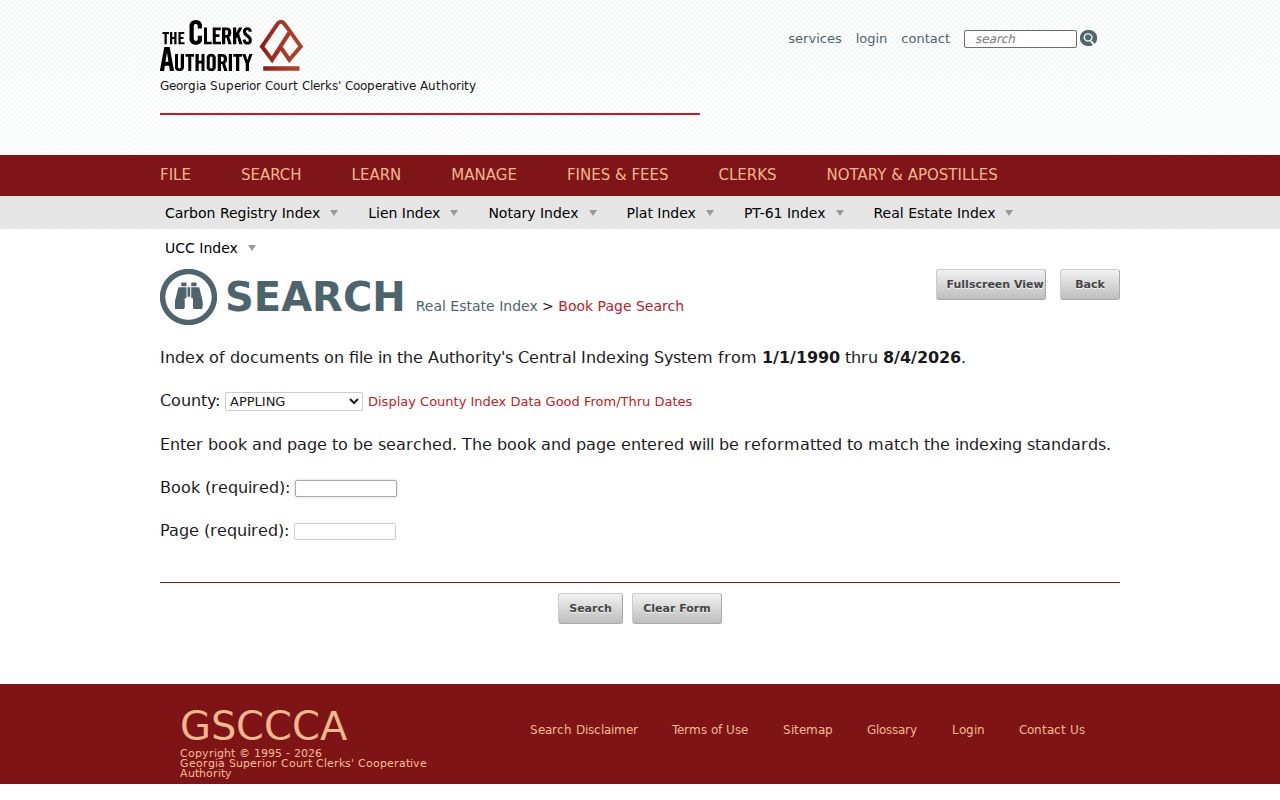
An exact book and page is worth preserving. When a deed or abstract supplies a citation, the Book/Page Search asks only for County, Book, and Page. Confirm the returned series and legal description against your chain. If the remote image fails, the Clerk can help. The Clerk provides a public terminal at 93 Front Street, Room 118, Cuthbert.
Walk Randolph's Grantor-Grantee Index
The grantor conveys the interest. The Randolph County index points to documents, and each deed then supplies the next names, its citation, and a legal-description check.
- Find the current claimant's acquisition deed with that party as grantee.
- Read the grantor, date, deed type, citation, and description.
- Search the grantor as an earlier grantee and repeat while the land description remains continuous.
- Mark any gap and move to the public terminal or historical books.
- Grantor
- The conveying party.
- Grantee
- The receiving party.
- Chain of title
- The connected sequence of conveyances.
- Book/page or instrument number
- The retrieval citation, copied exactly.
Interpret the 1865 and 1990 Leads Carefully
Kofile's "County Indexes Since 1865" label sounds complete. It promises no such thing for every instrument image. GSCCCA displays a portal-wide range of January 1, 1990 through August 4, 2026, and that text is not Randolph County's verified cutoff. Ask the Clerk for the county's true good-from and through dates and its oldest grantor and grantee books.
Follow PT-61 and Plat References
The Clerk's guidance covers filing basics. Most Randolph County deeds need an online PT-61 and transfer tax unless exempt, and corrective deeds follow a different path. Georgia plats have been filed electronically since January 1, 2017 under O.C.G.A. §15-6-67, though Randolph plat images carry no online guarantee.
Watch Randolph Filings for Fraud Signals
Randolph County runs no deed-alert service. Save any unfamiliar instrument number, date, parties, and image. Then contact the Clerk and a Georgia real-estate attorney, and read the state's title-theft guidance for current safety context.
Request a Randolph County Deed Copy
View an available image online or at the public terminal. For a plain or certified copy, call 229-732-2216 or write P.O. Box 98, Cuthbert, GA 39840 with the parties, instrument type, county, date, and citation. Ask about current fees, payment, mailing, and certification because no verified county schedule was published.
Recorded, not guaranteed. Randolph deed records show what reached the public index; they are not a title opinion and may not reveal unrecorded interests.
Separate Randolph Conveyances and Encumbrances
Separate the tracks. Deeds and debt differ. Warranty, limited-warranty, quitclaim, gift, administrator, executor, trustee, sheriff's, tax, and corrective deeds can convey or clarify an interest. Security deeds, assignments, modifications, extensions, subordinations, cancellations, and releases describe debt instead. Easements, rights-of-way, boundary agreements, covenants, declarations, plats, replats, and abandonments shape use or legal description. Federal and state tax liens, judgments, mechanics liens, and lis pendens may affect transaction risk. But an index entry alone cannot establish validity, priority, or enforceability.
Party capacity matters. One name may appear individually, as trustee, executor, estate representative, or officer of an entity. A lender changes sides. It can be grantee on a security deed. It can be grantor on the cancellation. It never takes fee title to Randolph County land. Record each capacity and instrument label exactly. Search organization names in full and abbreviated forms, testing fiduciary or estate wording when the chain crosses a death or trust transfer.
Research Randolph's Older Deed-Book Era
Older citations need a handoff plan. When the modern index stops, record the last confirmed grantor, grantee, date, and instrument type. Also record book and page and legal-description continuity. Ask the Clerk which grantor and grantee indexes cover the gap. Ask which deed books, microfilm, and plat books cover it too. The terminal may hold access the public web never shows. Kofile's 1865 statement is a starting point. It does not prove completeness from that year forward. It does not prove that every Randolph County deed image or instrument category is complete.
Older eras offer leads. Georgia Historic Newspapers carries Randolph legal notices. It also carries sheriff's sales, estate notices, tax sales, and old road names. The Digital Library of Georgia holds an 1867 county map and local collections. Historical tax digests can place a person and taxable real estate in a militia district. Probate files may name estates and heirs. These are leads, not deeds. Connect each one to a recorded conveyance, or state the unresolved interval plainly.
Compare Legal Descriptions Across Randolph Deeds
One party often held several tracts. Names and dates alone cannot separate them in Randolph County deed research. Compare district, land lot, section or GMD, acreage, lot and block, subdivision, road and creek calls, adjoining owners, easements, and prior-deed references. Georgia land-lot geography can outlast a street address change. A discrepancy may come from a split, combination, road taking, new survey, corrective deed, or estate proceeding. Record the conflict rather than picking the convenient number.
Plat Search fields can reconnect a land-lot description to a filed map. Electronic filing explains access to plats recorded since 2017. Older plats may sit in deed books. A map image helps orientation, but it cannot replace the recorded description or a survey, and boundary interpretation or title defects call for qualified professional review.
Prepare a Complete Deed-Copy Request
A complete request starts with the essentials. Tell the Clerk the county, the instrument type, the parties, the recording date, and the book/page or instrument number. Say whether a plain or certified copy is needed. Also state how you want it delivered, by mail or another method the office offers. Randolph County publishes no fee schedule for copies. So confirm the current charge and accepted payment before you mail anything. For a long chain, request one citation at a time or arrange terminal research. Staff can retrieve records, but they will not build a title abstract for you.
Inspect every copy the moment it arrives. Check the certification, page count, margins, attachments, recording stamp, legal description, and any referenced exhibits. One missing exhibit or unreadable page can gut an otherwise complete copy. Preserve the source and date. Then link the document to its correct position in the chain. Remember that recorded status never guarantees clear title. And the Clerk cannot issue a title opinion.
Audit a Randolph Deed Chain Before Using It
Read the chronology in both directions. Every grantor should trace back to an earlier acquisition. Every grantee should connect forward to the next relevant conveyance. Estates, court proceedings, entity changes, and unrecorded interests can all interrupt that pattern. Confirm the property description stays continuous across deeds, and watch for a similarly named party who owned a different tract. Flag any gap, overlapping date ranges, changed acreage, inconsistent capacities, or citations pointing to another book series.
Next, inspect non-conveyance filings around each transfer. A security deed recorded soon after acquisition often explains the financing. A later cancellation may close that track. An assignment swaps the secured party, not the landowner. Easements, covenants, boundary agreements, and plats can survive later deeds. Probate and court material may explain a transfer that breaks the ordinary grantor-grantee sequence.
Keep a working table for the chain. Track recording date, execution date, grantor, grantee, capacity, instrument type, citation, description clue, image status, and source. Recording and execution dates often differ, so label both. Never declare a chain complete while an older book, missing image, unreadable exhibit, or unverified county cutoff interrupts it. Name the missing span instead, and note the next retrieval route.
When authenticity matters, order certified copies. Ask a Georgia real-estate attorney or a qualified title professional to interpret ownership, enforceability, and priority. Randolph Clerk staff can locate and certify records. They cannot offer legal conclusions. That line matters. It protects the difference between finding a deed and proving a sound title position.
One last quality pass: confirm that every image, citation, and name-search result came from an official route. GSCCAA portal dates and availability can shift. So run a narrow search again before relying on any result. If a lookup will not reproduce, fall back on the Clerk's telephone and terminal route. State the limitation plainly. Randolph County deed records work best when a reader can move from a party name to an index row, then from that row to the full instrument. The reader can then move from the instrument to the next verified deed without ever losing the land description.