
The Randolph qPublic landing carries the official assessment context and the published-roll warning.
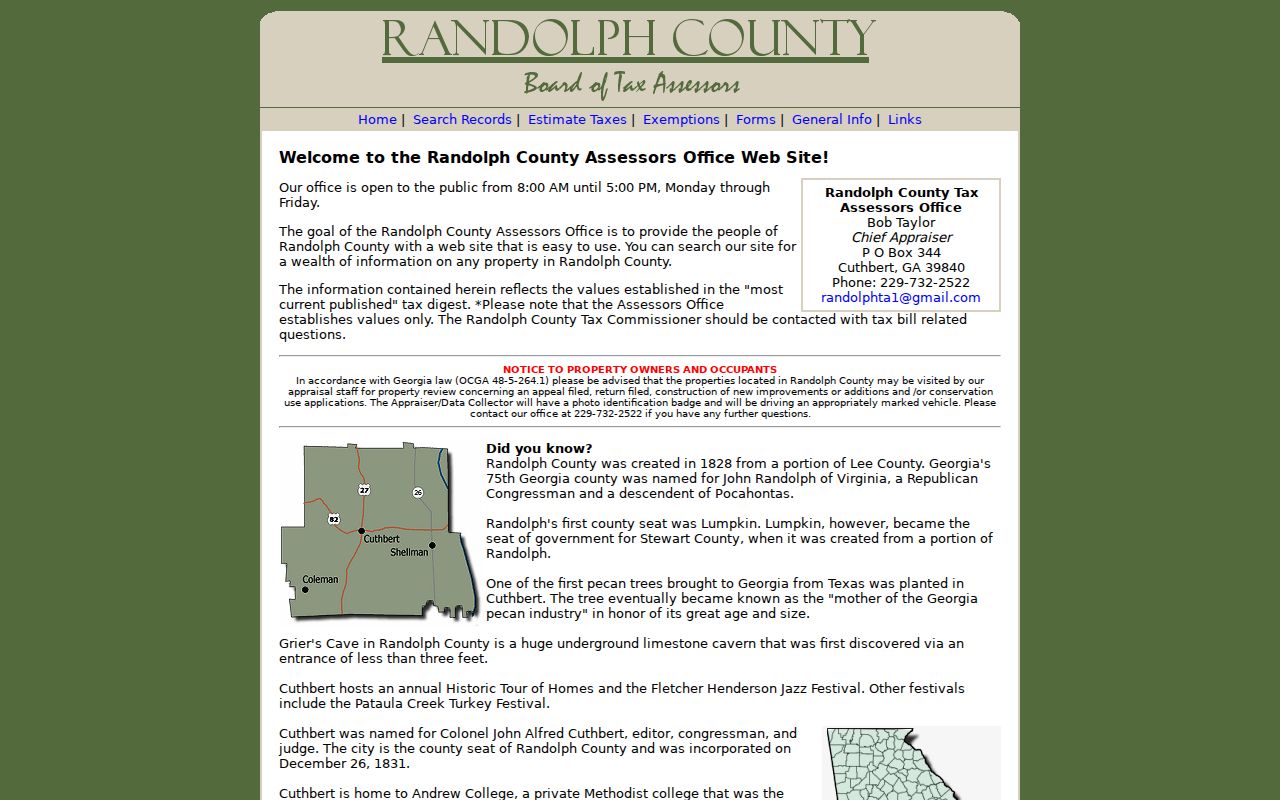
Think of this page as a route to assessment data. It is not proof of any parcel's assessed value.
Compare Randolph County Property Value Types
Read the label before the amount. Beacon's live Randolph County card is unavailable, so its exact display cannot be confirmed. County exemption material supports a common Georgia 40% assessed-value basis, but each field keeps the source's own name.
| Value | What It Is | Where |
|---|---|---|
| Assessed value | Tax-assessment amount tied to the statutory basis | Assessor roll |
| Fair-market field | Mass-appraisal estimate if the Randolph card displays it | Assessor roll |
| Taxable value | Amount after applicable exemptions or classifications | Assessment record |
| Sale or consideration | A transaction clue that may not be an open-market sale | Deed or PT-61 layer |
Standard homestead and other exemptions can shrink the taxable figure below the assessed one. Agricultural assessment at 30% and conservation-use current-value treatment can shift the relationship among market, assessed, and taxable numbers even further.
Read Randolph County's 2020 to 2025 Digest
The official 2025 digest describes the county tax base, not any parcel appraisal. Gross digest climbed from $256,330,203 in 2020 to $342,338,671 in 2025. Exemptions grew from $76,154,346 to $113,252,930. Net digest reached $229,085,741.
The 2025 M&O rate shown was 17.1311, and total M&O taxes levied came to $3,924,491. The county notice flagged a 3.97% net-tax percentage increase for 2025. These are countywide figures. They do not mean every Randolph County property value rose by that amount.
Separate Randolph County Exemptions From Value
Homestead, age-based, and disabled-veteran treatment can each move the taxable number. So can agricultural and conservation-use treatment. Standard homestead works as a $2,000 deduction from 40% assessed value. It applies to specified levies. Qualified agricultural property may use a 30% basis. Conservation use rests on current-use value under a ten-year covenant.
Never infer an exemption from an owner's age, name, or visible land use. Check the record and assessor approval instead. For bill calculation and appeals, see the Randolph County property tax guide.
Estimate Randolph County Value From Official Records
The county tax-record page leads to qPublic and notes that assessment information comes from the last certified roll while other data may change. Treat that certification date as part of the value itself.
- Find the parcel and confirm its situs, identifier, legal-description clue, and year.
- Copy each value field, including land, improvements, exemptions, and classification if displayed.
- Locate the latest deed or PT-61 clue and record the type and date.
- Explain why a gift, correction, family transfer, or foreclosure may not be comparable.
- Assessed value
- The value produced for the assessment process.
- Market value
- A market estimate, not necessarily a current offer.
- Assessment ratio
- The relationship between the assessment basis and market value.
Interpret Randolph County Sale Evidence
A recorded consideration amount or PT-61 entry is a transaction layer. It is not a verdict on worth. Set it beside the deed's parties, legal description, date, and instrument type. A transfer may be a gift, family transfer, corrective deed, foreclosure, estate deed, or partial-interest conveyance. Such a sale may not reflect an arm's-length market price.
The clerk's land-record route is the source for the deed itself. The assessor's last-sale field, when the live card shows one, is a clue to cross-check. It is no substitute for that instrument.
Verify Randolph County's Revaluation Timing
The county's published pages state no fixed annual reassessment cycle. They also name no last countywide revaluation year. Annual notices and the certified roll prove assessment work happens. But they support no invented uniform date.
Ask the Board of Tax Assessors about the roll year. Ask about model or neighborhood changes. Ask how sales feed review. Record the date of the answer. A value without its source year is easy to mistake for a live estimate.
Note: The county assessor handles valuation; the Tax Commissioner handles bills, payment, and delinquency.
Compare Randolph County Land and Improvements
If the live card splits land from improvements, copy both exact labels and amounts. Their sum may relate to a fair-market field. Assessed and taxable numbers follow separate steps. Do not assume every parcel card shows this split until a Randolph result confirms it.
For vacant, agricultural, and conservation-use tracts, classification can matter more than any building value. For an improved parcel, mass appraisal still cannot document interior condition. It also cannot show every change since the appraisal date.
Use Randolph County's Value Fallback Channels
If Beacon will not load, contact the Tax Assessor at P.O. Box 344, Cuthbert, or by phone at 229-732-2522. Ask for a parcel-specific assessment record. Name the situs, owner text, or parcel citation you already have. Office hours run 8 a.m. to 5 p.m. weekdays.
For a sale clue, use the GSCCCA name or book/page route. You can also use the Superior Court clerk's public terminal. Keep the assessor's value date separate from the deed's execution and recording dates. For general lookup mechanics, see the property search guide.
A licensed appraisal answers a different question. It analyzes one property and the market evidence for a stated purpose and date. The assessor's record stays valuable because it gives Randolph County a consistent public framework. But that consistency is not a sale forecast. Keep each product in its lane. Use the county's own language when you describe fair-market, assessed, or taxable amounts in property records.
Build comparisons honestly. Give each source its own row instead of blending one value. List the source name, field label, and amount. Add the effective year or transfer date, exemption or classification note, instrument type, and retrieval date. That layout exposes a stale tax roll, a non-market transfer, or a taxable-value deduction. It catches each problem before it distorts your estimate of the parcel.
The official digest archive shows how Randolph County reports gross value, exemptions, net digest, rate, and levy across years. It cannot give you a neighborhood trend. The county publishes no Cuthbert or Shellman value series. So do not infer a city trend from the county total.
Use digest numbers for scale and direction only. Gross digest covers many parcels and shrinks to net digest after exemptions. The M&O rate and total taxes levied describe county finance. But one owner's tax bill also turns on district rates, exemptions, and special assessments. Mixing those levels yields a false parcel estimate.
A recorded sale needs screening too. Confirm the same land was conveyed. Then ask whether the deed reflects a market sale, gift, family transfer, correction, estate transaction, foreclosure, or partial interest. A wide gap between sale consideration and assessed value may say more about the transaction than about the assessor.
Understand What Randolph County Value Cannot Prove
An assessor value is a mass-appraisal figure built for taxation. It can lag a transaction. It can carry statutory classifications. And it can differ from a negotiated price. Countywide digest movement says nothing certain about one parcel's condition or its likely sale terms.
Value versus price. Randolph County assessed value is not a promise of what land will sell for, and it is not an independent appraisal.
Value records prove none of the things people hope they might. They do not establish boundary size, zoning permission, flood risk, building condition, or clear title. Acreage and classification can shape an appraisal, but each fact needs its own source. A parcel map is not an appraisal. A deed price is not an assessment notice.
Match dates before you match numbers. A 2025 digest figure, an older certified parcel roll, and a newly recorded deed can each be accurate for its own event yet produce very different amounts. Place the source year beside every figure. Never average unlike evidence into a made-up current value.
Disputes follow a separate path. When a landowner contests taxability, value, uniformity, or a denied exemption, the Randolph County assessment notice opens an appeal. The county sets a 45-day window from the notice date. That procedure belongs with tax records. It does not change what the source fields in the deed and property records mean.